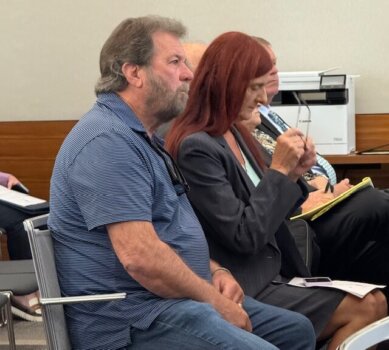
Liberty Fence’s James Saizan (foreground) with attorney Kim Landry (file photo).
Last year Mayor Tim Riley was served with the Petition for Mandamus against the City of Gonzales, filed by Liberty Fence & Supply LLC (Liberty Fence) on October 9. Liberty Fence, owned by James Saizan and represented by Kim Landy, sought satisfaction of five outstanding invoices submitted to the city in February 2025 totaling $23,600. On June 9 Judge Steven Tureau rendered judgment:
IT IS ORDERED, ADJUDGED, AND DECREED that the plaintiff’s Petition for Mandamus against the defendants is hereby DENIED.
Due to concerns of “overbilling” by Liberty Fence, Mayor Riley ceased all business with the company after a 13-year relationship it had with the city. During the 2024 calendar year (Riley was sworn into office on January 6, 2025) the City of Gonzales paid 189 separate invoices totaling $1.38 million to the company that had no license to do business in the State of Louisiana. Riley also refused payment of outstanding invoices because “the city incurred expenses to fix or redo jobs Liberty Fence had done in a substandard, unworkmanlike manner.”
-

- New sidewalk at Gonzales Municipal Park
-

- Liberty Fence’s $27,540 invoice to install a $2,012 floating dock
The city pleaded the affirmative defense of offset in its answer to Liberty Fence’s mandamus action.
A summary hearing of the case was conducted on March 23, resulting in Judge Tureau’s Reasons for Judgment which analyzed the matter before rendering a decision.
“In the Petition for Mandamus and at the March 23, 2026 hearing, it is undisputed that the Plaintiff entered into oral bids with the Defendant which were accepted shortly thereafter. Since all the disputed invoices were the result of oral bids with the Defendant, there is no written contract to analyze. The Plaintiff maintains that payment was owed because work was completed and the corresponding invoices were submitted to the Defendant. However, the Plaintiff did not introduce any exhibits that would support its claim that payment became due and payable under the oral contract when work was completed and the invoice submitted.”
The Judge cited case law in which the court “emphasized that the provisions under the contract did not mandate payment under the circumstances present in the case and allowed the defendant discretion when the provisions of the contracts were not met. Accordingly, the First Circuit held that the defendant’s decision in withholding payments was not arbitrary or without reasonable cause thereby justifying the denial of its writ for mandamus.”
In another case, “the court was able to analyze the contract between the parties and ultimately determined that the defendant was given discretion in rendering payment.”
In the Liberty Fence v. City of Gonzales litigation “there is no writing that can be examined to determine whether the Defendant had any discretion to decide when to remit payment under the terms of the oral contract.” Thus, Judge Tureau found a Fourth Circuit case analogous because it concerned a change order without written agreement. The Fourth Circuit found that “the failure to introduce a contract was dispositive because the court could not determine when payment was due without reviewing the terms of contract.”
Judge Tureau “was left to determine the existence and terms of the contract by evidence and testimony offered at the hearing. In discussing the work that was performed, both (the city supervisor) and James Saizan (of Liberty Fence) gave conflicting testimony as to the extent of the work performed and whether the work was properly completed. This raises concerns about the existence of the contract between the parties. A contract is formed by consent of the parties established through offer and acceptance and may be made in writing orally. If there is no meeting of the minds between the parties, consent is absent, and the contract unenforceable. The party seeking to prove the existence of an oral contract thus bears the burden of proving entitlement to payment for work allegedly completed. As previously stated, there were multiple inconsistencies in the witnesses’ testimony as to the work to be performed, casting doubt on whether the parties mutually consented to the terms and obligations contemplated by the contract. Even if an oral contract existed, reasonable cause for nonpayment remains because there is no written agreement establishing when payment became due and payable. Louisiana jurisprudence allows mandamus relief only when the public entity has no discretion regarding its payment obligation. This standard cannot be met herein as the payment terms are undefined.”
IT IS ORDERED, ADJUDGED, AND DECREED that the plaintiff’s Petition for Mandamus against the defendants is hereby DENIED.
There is, according to one legal expert consulted, nothing to stop Liberty Fence from seeking appellate relief or conversion of the mandamus action to a regular action.
“We sort of hope they do refile the suit since we’d love to have an opportunity to depose Mr. Saizan,” assured Mayor Riley’s Chief of Staff, Wade Petite. “The administration wanted to sue Liberty Fence last March, but a majority of the council had no interest in getting to the bottom of this mess.”
Licensing Board for Contractors dings Liberty Fence on six charges | Pelican Post – Online Newspaper
Whether or not that happens, the Liberty Fence saga may be resolved in court, not civil but criminal court.
Licensing Board refers criminal charge of Saizan/Liberty Fence | Pelican Post – Online Newspaper
 Loading ...