
Gonzales City Attorney Allen Davis provided an opinion from Louisiana’s Attorney General after three council members vociferously criticized Mayor Tim Riley during a Budget Workshop this week. Terri Lambert, Cynthia Gray James and Kirk Boudreaux launched a joint attack against a handful of salary increases, anticipating Monday’s vote on the 2026-27 budget. “We need to bump those salaries back down, every one of them,” Lambert declared without addressing much of anything else.
She “guessed, half-a-million dollars in excess raises” were extended to half-a-dozen or so employees. A spectacularly ridiculous claim, Lambert was only getting started
“This is how city’s go bankrupt,” warned Councilwoman Lambert who has demonstrated complete indifference to more egregious waste of taxpayer dollars.
Gonzales’ 2024-25 Fiscal Year audit cites Liberty Fence fiasco | Pelican Post – Online Newspaper
“It’s discriminatory in some kind of way,” she concluded. “I’m gonna just leave it at that.”
Lambert’s protestations evidence total incomprehension of Louisiana’s Local Government Budget Act and its requirements for presentation and adoption of municipal budgets. Along with her colleagues, utter ignorance of the Lawrason Act, whereby “All municipalities shall be governed,” is even more disturbing.
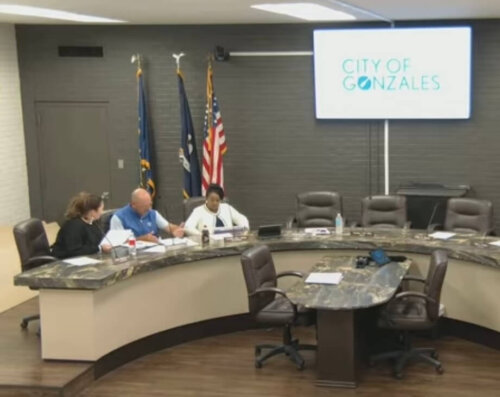
(L-r): Terri Lambert, Kirk Boudreaux and Cynthia Gray James powwow prior to Budget Workshop on Tuesday.
So much so, apparently, that the City Attorney was compelled to provide a copy of La. Atty. Gen. Op. No. 12-0056, summarized:
“The board of aldermen in a Lawrason Act municipality may not usurp the power of the mayor through the passage of an ordinance. The board does not have the authority to hire, fire or discipline municipal employees. Nor may it participate in an employee annual review process or modify their pay.”
Municipal budgets can only be adopted by ordinance. As to those mayoral powers, they are found in the Lawrason Act, specifically R.S. 33:404 which reads in pertinent part:
A. The mayor shall have the following powers, duties, or responsibilities:
(1) To supervise and direct the administration and operation of all municipal departments, offices, and agencies, other than a police department with an elected chief of police, in conformity with ordinances adopted by the board of aldermen and with applicable provisions of state law; however, no such ordinance may limit the authority granted to the mayor by this Paragraph. All administrative staff shall be subordinate to the mayor.
(2) To delegate the performance of administrative duties to such municipal officers or employees as he deems necessary and advisable.
(3) Subject to applicable state law, ordinances, and civil service rules and regulations, to appoint and remove municipal employees, other than the employees of a police department with an elected chief of police. However, appointment or removal of a nonelected chief of police, the municipal clerk, the municipal attorney, or any department head shall be subject to approval by the board of aldermen, except that in the case of a tie vote, the recommendation of the mayor shall prevail.
9) To have any other power or perform any other duty as may be necessary or proper for the administration of municipal affairs not denied by law.
Analyzing the mayoral powers versus governing authority attempts at usurpation, the Attorney General wrote, “A state statute takes precedence over any and all local ordinances, and state statutes cannot be modified by any inconsistent local ordinances. It is well settled that local government is without authority to enact ordinances which are inconsistent with or in contravention of state law.
In conclusion, outside of specific exceptions outlined in R.S. 404(A)(3) (see above), the Board of Aldermen does not have the authority to hire, fire or discipline municipal employees. Further, the mayor alone has the power to conduct an annual review and determine if pay raises are warranted for municipal employees.”
The opinion goes on:
- The board of aldermen has the power to set the compensation for municipal officers pursuant to R.S. 33:404.1. Municipal officers are the mayor, aldermen, chief of police, tax collector and clerk. (R.S. 33:381)
- The board may increase or decrease the pay for nonelected municipal officers and can increase the pay for elected municipal officers.
- The board may not alter the pay for any other municipal employees, as that would be a usurpation of the mayor’s authority.
- The mayor alone has the authority to give pay raises to municipal employees who are not municipal officers subject to the constraints of the Local Government Budget Act.
Gonzales’ municipal code is replete with ordinances that “contradict Lawrason Act provisions and other state law” according to Mayor Riley. He made that very point as Councilman Kirk Boudreaux, still recovering from the mauling administered by Riley’s Chief of Staff one day earlier…
Three council members do battle with Chief of Staff | Pelican Post – Online Newspaper
insisted that he be provided an Itemized Budget/Salary Chart. Reminded by Councilwoman Lambert that he had already been provided the chart, Boudreaux defiantly asserted that “I want an updated one.”
“You think that’s funny mayor? Just give me a new copy,” Boudreaux was having a hissy fit. “That’s all I’m asking and I don’t think that’s funny that I asked for that.”
Riley reminded the emotionally fragile councilman that he had been provided the chart. If he desired an updated version, he could have requested one prior to Tuesday’s workshop.
“So, you think it’s funny? You laughed at me. I don’t deserve to be laughed at,” he was verging on hysteria at this point. “I take that personally, okay! Like me laughing at you, mayor.”
“I’m sorry if I offended you, Kirk,” the mayor apologized.
“You still think…you’re still laughing,” Boudreaux could not shake it
Mayor Riley called on Jacob Waguespack, the budget’s architect to the podium when…
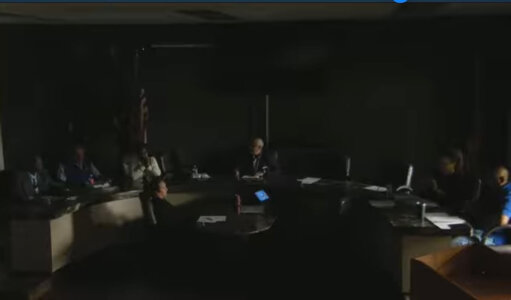
Blackout at Gonzales Council Budget Workshop (Tuesday)
Turn out the lights, the party’s over
They say that, ‘All good things must end’
Let’s call it a night, the party’s over
And tomorrow starts the same old thing again
Willie Nelson’s The Party’s Over
 Loading ...