Harvest Field (2) vote
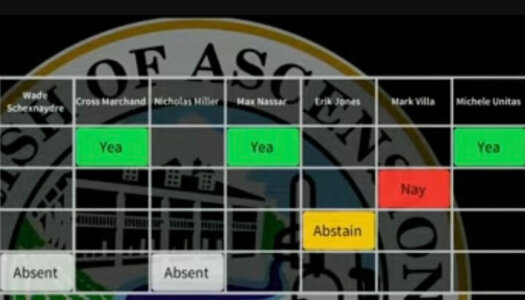
After an hours’ long, sometimes contentious public hearing, Ascension’s Planning Commission approved the controversial Harvest Fields subdivision preliminary plat. Already denied by a 5-0 vote in February, two of those members voted to approve the plat and a newly appointed member joined them to form a three-vote majority. Commissioners Max Nassar, Michelle Unitas and Cross Marchand (the new guy) voted to approve with Mark Villa holding firm in his denial.
Erik Jones abstained with Chairman Nicholas Miller and Commissioner Wade Schexnaydre absent.
Unanimous Planning vote denies Harvest Fields subdivision | Pelican Post – Online Newspaper
Does Harvest Fields subdivision preliminary plat meet all the criteria of the Unified Land Development Code (ULDC)? If it does, according to Dantin Bruce Development’s attorney, the plat enjoys “a presumption of validity” and the developer has a “use-by-right” because the proposed subdivision is properly zoned for its intended use.
Five months after a unanimous Planning Commission denial of its subdivision preliminary plat, Dantin Bruce Development sent its attorney to make its second pitch to the seven-member body responsible for approval/denial of the application. The mere fact that Harvest Fields subdivision was back on the agenda without waiting the purportedly requisite 12-month post-denial delay was already unsettling to dozens of subdivision opponents (27 speakers and nearly six dozen red card providers).
Resistance, with a few exceptions, centered on the Traffic Impact Analysis (TIA) of which the public had a wildly different interpretation than the parish’s consulting engineer, Shaun Sherrow. Sherrow shrugged off the Section 17-4060(G)(2) of the ULDC (the final piece of legislation adopted by the Parish Council in 2022 to end a nine-month moratorium on subdivisions):
A proposed development that is subject to TIA requirements of this section shall be denied when the results of the required TIA demonstrate that the proposed development will overburden the existing roadway system by causing a reduction in service of affected roadway system by causing a reduction in service of affected roadways. In the case where the existing Level of Service (LOS) is below “D,” the required mitigating improvements shall improve all approaches, legs, or any elements within the development area to an LOS of “D” or better.
The provision was part of a revamped development code, an effort by Parish President Clint Cointment’s administration aimed at imposing more stringent requirements during the moratorium in place from July 15, 2021 until May 31, 2022. Original language, had it not been watered down by the former Parish Council…
would have killed Harvest Fields.
Wednesday’s analysis of the change in TIA methodology was the most in-depth to date. A commission struggling to grasp its implications, Shaun Sherrow opined:
“You have to read it in the entirety and understand (inaudible) rather than one piece at a time,” he said. “I’ve heard, ‘you shall deny the project when there’s a low Level of Service or the LOS drops.
The traffic study does not show where they overburden the network. The statement is, ‘if they did overburden…you can’t go from an ‘E’ to an ‘F’, if you drop the Level of Service, you have to fix it,” Sherrow grasped at every available straw. “But, if you have to fix it, you can’t take it back to an ‘E’, you have to take it to a ‘D.’ There’s a bunch of sentences to interpret. The way this ordinance says they apply,” he wavered.
“If it’s been interpreted the way everyone is saying there should be no development. It would be a moratorium ’til every single intersection, even though the parish can’t control, is a ‘D’ or better in the entire parish.
That’s obviously not the case,” Shaun Sherrow declared.
Says who?
In fact, when President Clint Cointment pushed for the moratorium to halt development until more stringent ULDC provisions could be implemented, it seemed that improvement of those intersections was very much the intention. Former council members Teri Casso and, to a lesser extent, Aaron Lawler went to work helping out the developer friends, particularly Dantin Bruce Development in the case of Lawler.
And here we are.
MR Engineering argued that Harvest Fields will not “overburden the existing roadway system” because, according to the TIA, a mere eight out of a 1,078 total “a.m. trips” will be generated by the new subdivision after buildout. Presumably, that argument failed to convince a single member of the opposing public though it won over three of the four voting members of the Planning Commission.
Commissioner Mark Villa moved to deny the plat, but no second was forthcoming and it died. Chairman Max Nassar, after his cajoling of colleagues failed to elicit another motion (he called a recess at one point to regroup in the antechamber, or maybe for a bathroom break three hours and 35 minutes into the proceedings) reversed course and offered a motion to approve. His motion, too, died for lack of a second.
“Sadly, I think I failed you,” Commissioner Michelle Unitas qualified her successful motion to approve (contingent upon geotechnical and environmental issues being resolved).
After the commission vote, those regular citizens in attendance seemed to agree.
 Loading ...