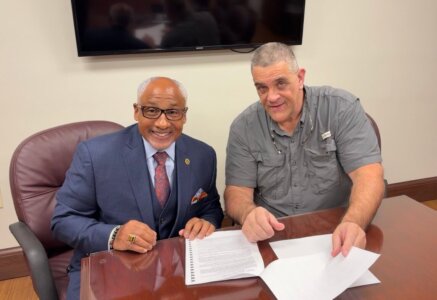
Mayor Tim Riley and Chief of Staff Wade Petite.
Whatever the City Council (minus Eddie Williams) hoped to achieve by yesterday morning’s Special Meeting to “discuss” a minor accident involving Mayor Tim Riley’s Chief of Staff, the charade blew up in their faces for all to see. Curiously, Terri Lambert absented herself from the festivities. Based on the false premise of ensuring Wade Petite be held to the same standard as other employees, the fools’ errand was doomed from the start.
“Disciplinary action is still under consideration since the accident is less than a week old,” explained Mayor Riley. “We haven’t even received results from the employee’s drug screen. Why the council thought this was a good idea, I can’t say.”
Petite has been a trusted advisor to the mayor for more than a decade, going back to 2016 when Riley mounted an unsuccessful campaign for City Council. Trust and loyalty, precious but scarce political commodities, exist in abundance with the pairing.
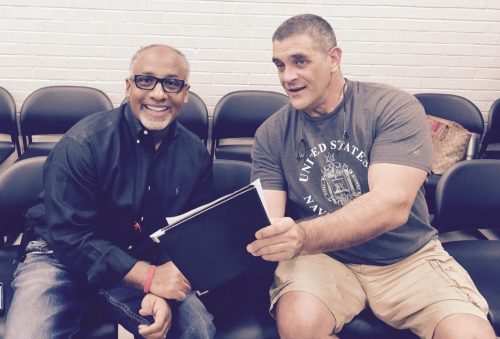
Two of the three candidates for Gonzales Division D council seat: Tim Riley (at left) and Wade Petite (2016)
“None of which should factor into the ultimate disciplinary decision,” Petite said after yesterday’s “dog and pony show” concluded. “Human Resources and the City Clerk have been involved in the process from the start and all I want is to be treated like any other employee. That did not happen this morning.”
The subject accident, a minor fender bender, occurred after business hours in the City Hall parking lot on Tuesday. Later that evening Petite was visited at home by two Gonzales police officers who issued a citation. By 9:00 a.m. on Wednesday media contacted Petite for comment which could not have happened without a leak from Gonzales PD, resulting in a Special Council meeting five days later as disciplinary action was still under consideration.
Is there another city employee who would be subjected to such treatment?
Seemingly unbothered by it all, Petite took the council on yesterday, insisting that the proceedings be conducted in the open when Councilman Tyler Turner moved to convene Executive Session.
“Executive Session is to protect the employee,” Wade Petite intervened. “I’m the employee and I want this done publicly. Let’s do it where everyone can see.”
Then came the show.
“Protocol was not followed,” declared Councilman Kirk Boudreaux who should know what he’s talking about after 17 years and three months on the council. “The rule is that when an employee gets in an accident, he calls his supervisor who picks him up to get tested.”
Petite, a former criminal defense lawyer, asked Boudreaux to provide a citation where the purported protocol might be read.
“That’s been the rule, the city protocol,” Boudreaux deflected. “It’s a rule everybody followed, Wade.”
“Where is that protocol memorialized?” Petite pressed him. “Or y’all just made it up for the last 17 years?”
In fact, Section 2-284.1 of Gonzales’ Employee Handbook (entitled Additional testing requirements; accident/injury) reads:
All employees under section 2-279…shall additionally be required to participate in the substance abuse screening procedure if the employee is involved in an on-the-job accident or sustains an on-the-job injury. For the purposes of this section: The term “accident” refers to any occurrence which requires treatment by qualified medical personnel, causes injury or fatality, produces damage to property or material, or interrupts and/or terminates scheduled work assignments. Any employee sent for testing under this section shall be driven by another employee and shall not drive themselves.”
Councilman Turner picked up the gauntlet, conceding (erroneously as it happened) that the code is silent but “precedent has been set.” Ignoring enacted law/policy to establish contradictory precedent will never hold up in a court of law (Turner should consult his daddy, a former District Court Judge). The third term councilman read the final sentence of 2-284.1 aloud, conveniently omitting the first two.
“During normal work hours, if someone gets injured, the supervisor is called,” Human Resources replied to the council member. But this was “after normal work hours” and no one was injured. The city vehicle did sustain minor damage (Petite already offered to pay for repairs).
“Has any employee ever left the scene of an accident,” Turner persisted.
HR could recall no such instance. Then came the ringleader of this insane clown posse.
“When we have an accident, can they wait ’til the next day (for drug screen)?” Councilwoman Cynthia Gray James inquired.
HR responded, “According to the handbook, we don’t have a time period. During normal business hours, the supervisor will call me and explain what happened.”
In this instance, Petite asked to convene HR, the City Clerk and Mayor Riley as soon as the mayor arrived at City Hall on Wednesday morning. He had alerted Mayor Riley at 6:45 a.m. Petite was instructed to proceed to drug screening at a local medical office.
“That’s strange, very strange,” Councilwoman James concluded before adding that “police always should be called.”
Petite was issued a citation by Gonzales PD under Revised Statute 14:100.
A. Hit-and-run driving is the intentional failure of the driver of a vehicle involved in or causing any accident, to stop such vehicle at the scene of the accident, to give his identity, and to render reasonable aid.
B. For the purpose of this Section:
(4) “Accident” means an incident or event resulting in damage to property or injury to person.
By all accounts, Petite did alert the other vehicle’s occupants that he worked at City Hall and could be contacted there. He ascertained that no injuries occurred and the other vehicle sustained no damage.

City owned vehicles are self-insured and Petite offered to pay to repair the damage in any event.
“THE rule was broken,” James insisted, failing to cite/read/or otherwise identify THE rule she had in mind.
Boudreaux reentered the discussion, claiming that his favored, unwritten policy/standard trumped the terms memorialized in the handbook.
“The standard has been set for years and years,” Petite referenced Section 2-284.1. “You’ve just ignored it for 17 years, councilman. You want to impose what you think is the right thing to do in place of the written policy.”
Councilman Turner came to the rescue, reading the second paragraph of Section 2-285 in the handbook:
The city council shall, after due consideration and deliberation, render a decision of suspension or dismissal. No further hearing shall be held and the decision of the governing authority is final.
But, according to City Attorney Allen Davis, the verbiage is contingent upon the preceding paragraph having occurred, which Turner omitted.
An employee aggrieved by the results of the substance abuse testing procedure shall be allowed to appear before the board of aldermen in private session for the sole purpose of requesting and presenting arguments to limit the severity of the penalty to be imposed…
How long has the policy been in place when it refers to “board of alderman” instead of “city council in the first paragraph?”
“Put another way councilman, what you just said has no application,” Wade Petite poked Turner. “What’s your next shot?”
Turner had none, but Cynthia James was not finished, opining that “the City Council should have some say so, so far as discipline.” Without legal support for the opinion, she “demand(ed) a stiff penalty.”
Disciplinary action against any employee, confirmed by the City Attorney, is the exclusive province of the mayor.
 Loading ...